
Lubrication of trapezoidal threads: how to extend the service life of your nuts
Lubrication is often underestimated when it comes to trapezoidal threads. However, it is one of the most important factors determining the service life of a trapezoidal thread nut. A suitable lubricant reduces friction between the spindle and nut, dissipates heat and helps remove wear particles from the contact area. Especially in dynamic applications, where the nut moves continuously, proper lubrication can make the difference between a short service life and years of trouble-free operation.
At Trapeziumdraad.nl, we have conducted extensive research into the influence of different lubricants on the service life of trapezoidal thread nuts. Based on thousands of test cycles, we investigated which factors have the greatest impact on service life. These studies resulted in three practical recommendations that can significantly extend the lifespan of almost any application.
1. Any lubrication is better than no lubrication
The greatest improvement is not achieved by selecting the perfect lubricant, but simply by applying lubrication.
During our practical tests, we found that an unlubricated trapezoidal thread nut began to show wear after a relatively low number of movement cycles. Once the same application was provided with lubricant, the service life increased significantly. Even the lowest-performing lubricants extended the service life many times compared to completely dry operation.
This can be easily explained. Without lubrication, direct metal-to-plastic or metal-to-bronze contact occurs. As a result, both friction and temperature increase rapidly. In addition, small wear particles remain between the thread surfaces, where they act as abrasive material and further accelerate wear.
A lubricant forms a protective film between the contact surfaces. This reduces friction, generates less heat and allows wear particles to be removed more effectively.
In short: if you can take only one measure to extend the service life of your trapezoidal thread, make sure that the spindle is properly lubricated.
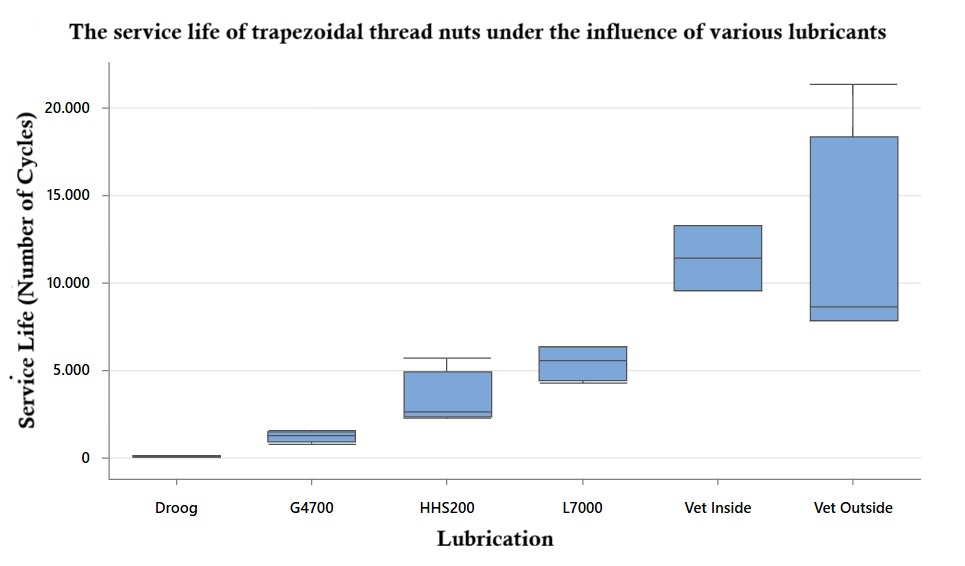
2. Choose a lubricant suitable for trapezoidal threads
Not every grease is developed for slowly moving spindle drives. Different lubricants behave differently under load, at high contact pressures or in humid conditions.
To determine which greases perform best, we tested various lubricants together with Mavom and DuPont on our trapezoidal thread products. During these practical tests, identical spindle-nut combinations were subjected to long-term loads, while only the lubricant used was varied.
The lubricants that achieved the best results during these tests are now available as:
VetInside – developed for dry and clean indoor environments.
VetOutside – developed for outdoor applications and conditions where moisture, dirt or changing weather conditions play a role.
By choosing a lubricant that is matched to the application, the lubrication film remains intact for longer and wear is further reduced.
3. Apply sufficient lubricant and check regularly
A common mistake is applying only a thin layer of grease in order to save lubricant. Although this may appear beneficial in the short term, it often results in a significantly shorter nut service life in practice.
During operation, part of the grease is displaced, contaminated or gradually pushed out of the thread grooves. When insufficient grease remains, the protective lubrication film disappears and friction immediately increases.
A generous amount of grease ensures that:
- the contact surfaces remain continuously lubricated;
- heat is dissipated more effectively;
- wear particles are absorbed by the grease instead of continuing to circulate between the thread surfaces;
- lubrication remains effective for longer between maintenance intervals.
This is especially important for trapezoidal threads. Due to the sliding motion between spindle and nut, friction is naturally higher than with, for example, a ball screw. Proper lubrication therefore provides relatively large benefits.
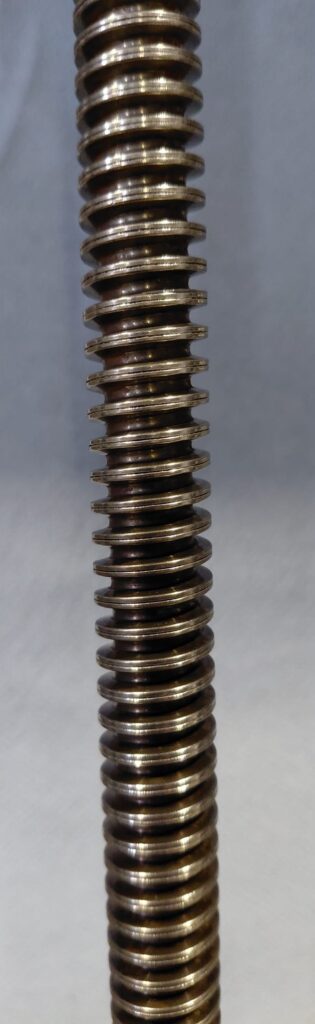
No Lubrication
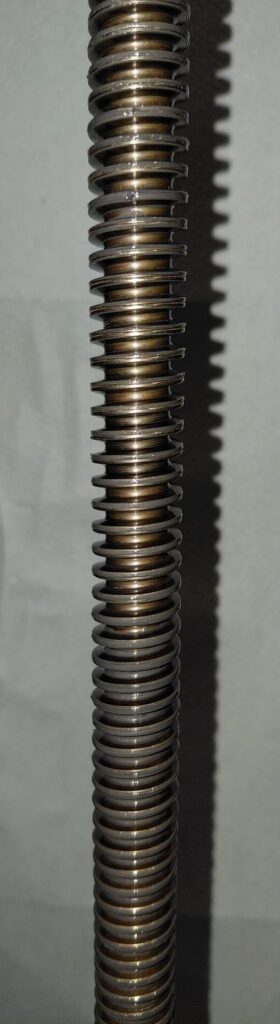
Insufficient Lubrication
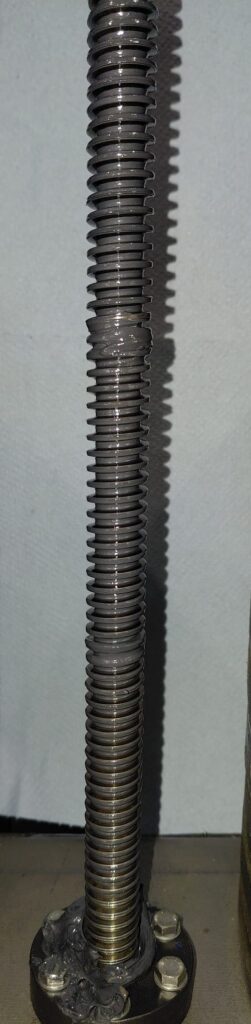
Sufficient Lubrication
Summary
The service life of trapezoidal thread nuts can be significantly extended by following three simple principles:
- Always lubricate.
- Use a suitable lubricant.
- Apply sufficient grease and regularly check the lubrication layer.
By applying these guidelines, wear, heat generation and friction are greatly reduced, significantly increasing the service life of both the spindle and the nut.
Are self-lubricating plastics maintenance-free?
Materials such as PETP-SL, PA6-MoS₂ and HDPE have self-lubricating properties. As a result, these materials can function without additional lubrication under certain conditions.
However, this does not mean that lubrication is unnecessary.
Even with these plastics, a suitable lubricant reduces friction, lowers temperature and significantly increases the permissible load. In practice, a lubricated plastic nut can therefore be used under more demanding conditions than the same nut without lubrication.
The table below shows the recommended maximum surface pressure for different materials, both with and without lubrication. Especially at higher loads, it becomes clear how much difference proper lubrication can make.
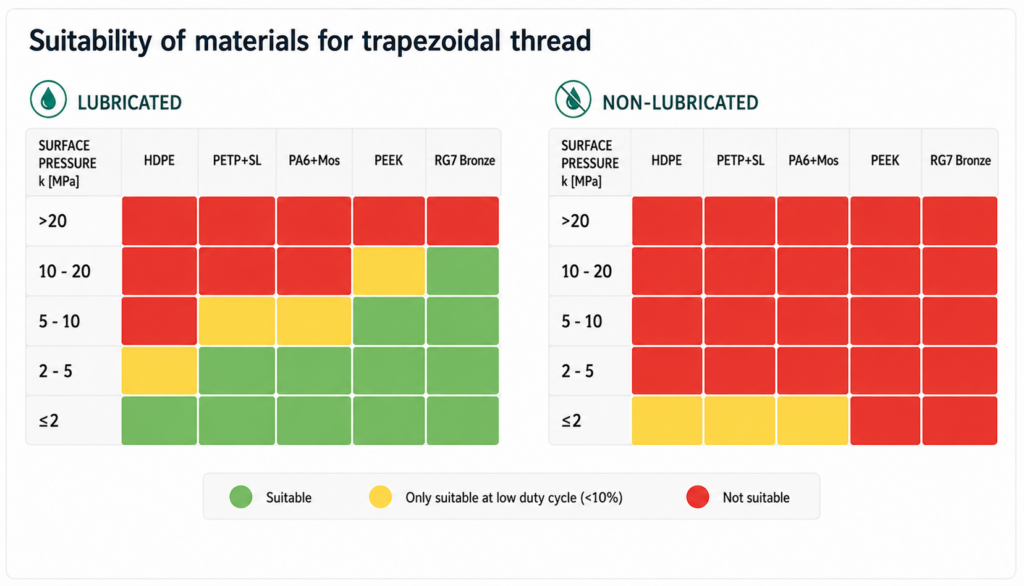
When selecting a plastic trapezoidal thread nut, it is therefore wise to consider not only the material, but also the possibility of periodically lubricating the spindle. In many applications, this provides a significant improvement in service life and operational reliability.