
As an engineer or machine builder, you regularly face the challenge of selecting the right linear drive. But what do you do when environmental factors work against you? Think of applications near dirty water, fluctuating temperatures, or aggressive chemicals. In a trapezoidal lead screw solution, the right combination of screw and nut materials is crucial for the lifespan and reliability of your construction. In this blog, we dive into the best material choices for challenging environments.
Which Material Do You Choose for the Trapezoidal Lead Screw?
When a lead screw is used in or around water, the choice is always stainless steel (SS) to prevent corrosion. But which grade of stainless steel do you need?
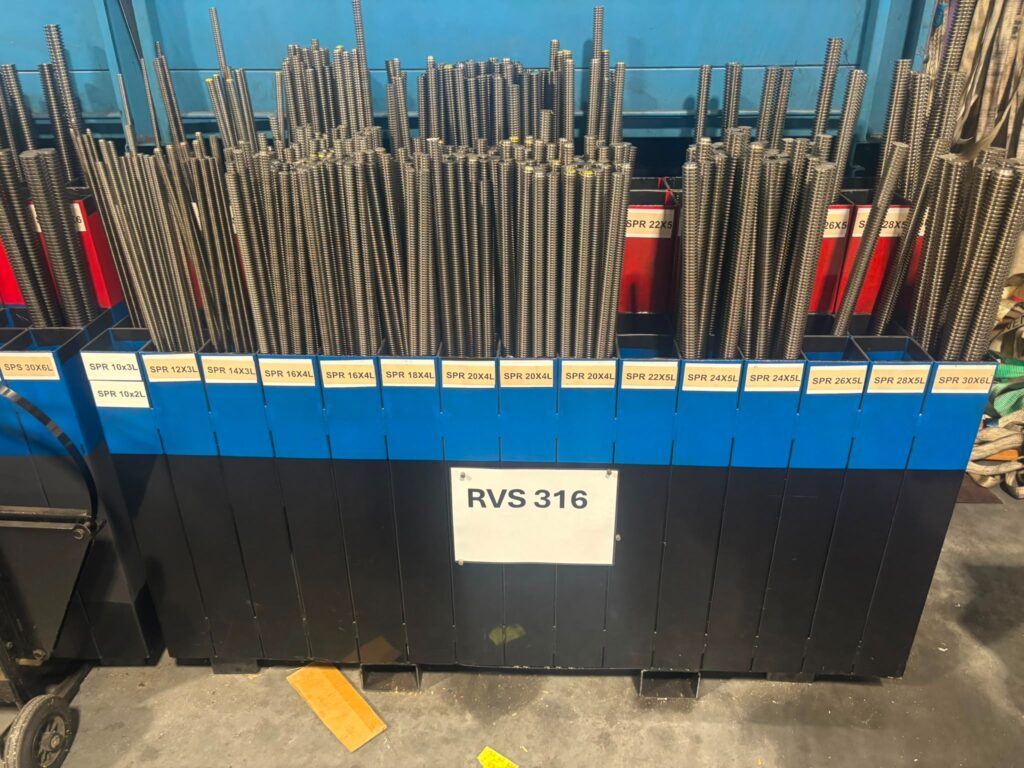
Stainless Steel 316 (A4): The Standard
In practice, customers often ask for A2 or A4 quality (better known as SS 304 and SS 316). To keep it simple: SS 316 can always be used where SS 304 is specified, but absolutely not the other way around. This is because SS 316 offers a much higher corrosion resistance. That is why we supply SS A4 (316) as standard. This material is:
- Strong and tough
- Seawater resistant
- Suitable for 99% of all applications in and around water
Duplex 1.4462: For the Extreme 1%
For the remaining 1% of extremely harsh environments, standard stainless steel is no longer sufficient. Think of heavy chemical industry applications where acids, extreme mechanical loads, and salt water come together. In those cases where the tensile strength of high-grade steel and extreme chemical resistance are required, we switch to Duplex 1.4462.
Which Material Do You Choose for the Trapezoidal Nut?
The lead screw is only half the story. The nut that runs over it largely determines friction, wear, and heat generation.
RG7 Bronze: For Dynamic Applications
The most commonly used material for trapezoidal nuts is RG7 bronze (a high-quality bearing bronze).
- Excellent sliding properties: Ensures minimal friction and smooth operation.
- High thermal conductivity: Bronze dissipates heat generated by friction rapidly. This makes it ideal for dynamic applications that move continuously or at higher speeds.
- Please note: Bronze does require lubrication to prevent premature wear (galling) on the stainless steel screw, especially in humid environments.
Plastic Nuts: The Solution for Specific Challenges
While bronze is the standard for heavy, dynamic loads, engineering plastics offer the ultimate solution for dirt, moisture, and lubricant-free (dry running) applications. In dusty or dirty environments, grease or oil attracts particles, which then act like sandpaper. Plastic resolves this. Depending on the exact environmental factors, we choose from three high-performance plastics:
- PETP+SL (Polyethylene Terephthalate + Solid Lubricant) PETP+SL is a modified plastic equipped with an integrated solid lubricant.
- Ideal for: Applications where external lubrication is absolutely undesirable or impossible, and where precision is required.
- Properties: It has an extremely low coefficient of friction and very high wear resistance. In addition, it absorbs virtually no moisture and shows minimal creep (deformation under constant pressure), keeping dimensions highly stable.
- PEEK (Polyether Ether Ketone) When temperatures rise or aggressive cleaning agents are involved, we switch to PEEK.
- Ideal for: The food industry (FDA-compliant), pharmaceuticals, and the chemical process industry.
- Properties: PEEK retains its mechanical strength and stiffness at very high temperatures (continuously up to 250°C). Furthermore, it is resistant to virtually all chemicals and can withstand repeated steam sterilization.
- HDPE (High-Density Polyethylene) For lighter, slower-moving applications in wet environments, HDPE is an excellent candidate.
- Ideal for: Water treatment plants, fishing equipment, or simple outdoor applications involving dirty water.
- Properties: HDPE is guaranteed to absorb 0% moisture and is highly chemical-resistant. It is a relatively tough and softer material, providing good vibration and noise damping at a very favorable cost. However, it is less suitable for high temperatures or heavy mechanical loads.