
Is your construction featuring a trapezoidal lead screw and nut suffering from creaking and squeaking? In this blog, we share our experiences with these types of issues and their corresponding solutions.
When the load on the trapezoidal lead screw and nut combination is too low, an annoying form of resonance can occur. The nut begins to vibrate against the screw. The resulting noise can be described as squeaking, creaking, or even screeching.
Practical Example
A customer built a construction with 4 columns, each containing a TR 40×7 trapezoidal lead screw. The length is 2.5 meters, and the final weight the construction needs to support is 3,000 kg. The screw rotates at 200 RPM. The customer reported that the screw was producing an annoying squeaking noise.
The Cause
During testing, the load was only 145 kg. Distributed over 4 columns with TR 40 screws, this is extremely low. An insufficient load is often the root cause of this problem. Fortunately, the customer informed us that after reassembling, lubricating, and increasing the load, the problem was completely resolved.
What if the Load Remains Too Low?
If the load remains too low, you can choose to increase the surface pressure by shortening the nut. Halving the length of the nut doubles the surface pressure. This can immediately cause the vibrations to disappear.
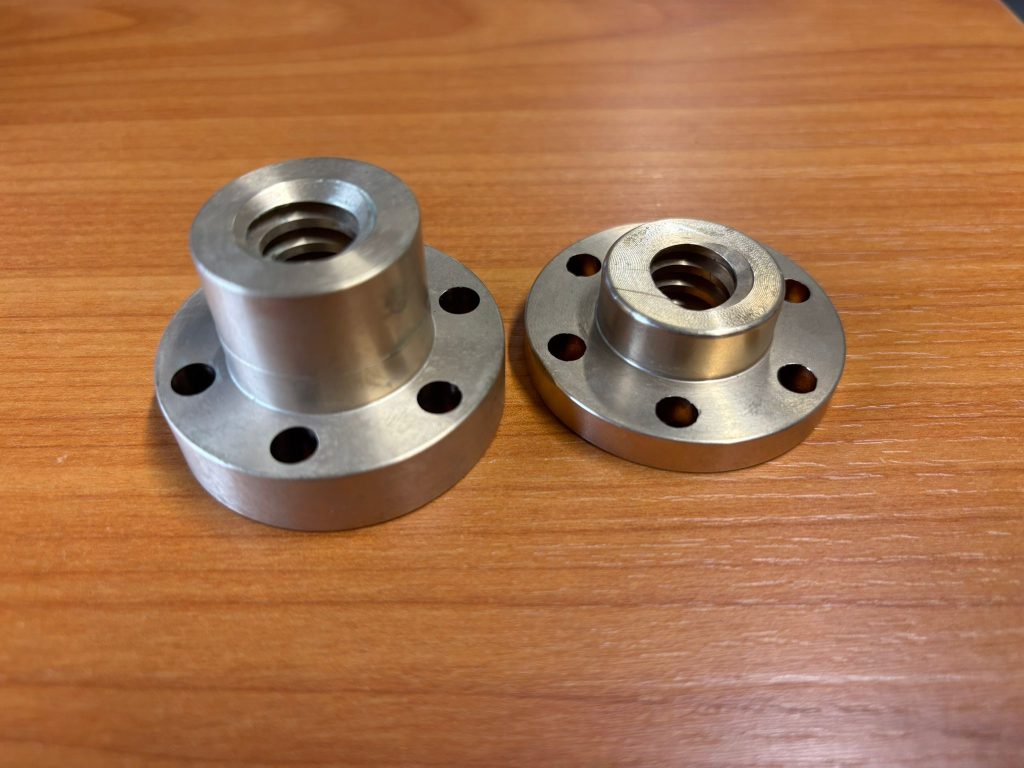
Lubrication
Without proper lubrication, this annoying noise can also occur. Lubrication is incredibly important for trapezoidal lead screws. Allowing steel, stainless steel, and bronze to rub against each other dry causes significantly more friction and increases the likelihood of vibrations. Therefore, always ensure adequate lubrication.